Subscribe

Subscribe to receive new posts:
Available Now!
When Judaism Meets Science


Posts Tagged ‘evidence’
Copper, Tin, and Bronze in the Hebrew Bible
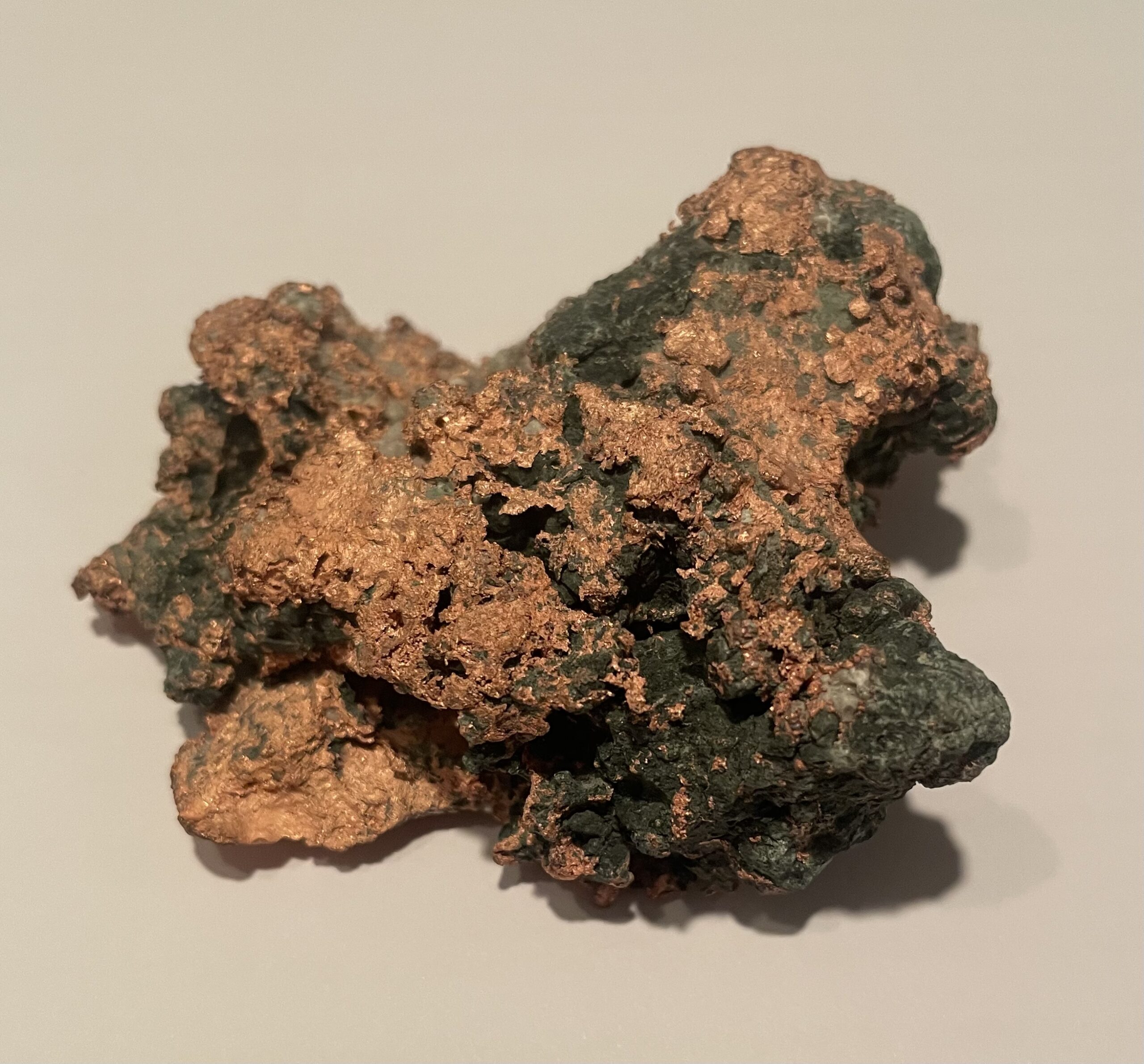
Native Copper – Credit: Roger Price
From about 1550 BCE to 1200 BCE, gold may have been the marker of wealth and silver the metal of commercial currency in the Ancient Near East (ANE), but that time period is known as the Late Bronze Age. The Early Bronze Age in the ANE began around 3000 BCE when some unknown metallurgist realized that melting copper (Cu) with tin (Sn) would make the resulting substance, or alloy, stronger than copper alone. But prior to that discovery, copper’s use, without any purposeful chemical additions, went unchallenged for perhaps over six millennia. In the ANE, copper began to replace stone as the material of choice for a variety of uses such as tools, weapons, and decorations possibly as far back as 8700 BCE, as evidenced by a copper pendant dated to that time which was discovered in what is present day Northern Iraq.
Copper
Copper’s supremacy, in the ANE and around 5000 BCE in other places like the Indus Valley in the Indian Subcontinent and the Upper Peninsula of Michigan in the United States, arose from a happy coincidence of several factors. Copper was, like gold and silver, two other elements in Group 11 of the Periodic Table, an element that existed in the solid phase under Standard Temperature and Pressure conditions, that is, at 32oF (0oC) and 1 atm (atmosphere). While it could be found as a carbonate (e.g., malachite), as a sulphate (e.g., chalcanthite), and as an oxide (e.g., tenorite), among other sources, it could also be found in its native metallic form. By itself, copper appeared as a reddish-brown metal, one that could be seen on the ground as nuggets and available for the taking in those locations where it existed. Today an interested person can still purchase native copper from shops located in old copper mining areas.
read more
The Myth and Function of the Passover Plagues
Passover is a wonderful holiday. It is a time to gather together with family and friends. It provides an opportunity to reconnect with the millennia old line of the Jewish People. On Passover, we reach back through the mists of time to the myths of our national origin. We seek to find lessons from the distant past which might guide us in our present.
The highlight of the festival is the reading of a story from the Haggadah, literally meaning “the story.” The story tells of the enslavement of ancient Israelites in the land of Egypt and their release from bondage following a series of ten calamities, commonly understood as plagues, which devastated Egypt. Those plagues, in the order of the story in the Book of Exodus are blood, frogs, lice, insects, pestilence, boils, hail, locusts, darkness and the death of the Egyptian firstborn. (See Ex. 7:14-12:30.)
Today that core story, and its centuries of embellishments, is read, sung and discussed throughout the Passover seder (a ritual meal, literally “order”). All along the way we are requested to, challenged to, even required to ask questions, to probe into the meaning of the story. The whole exercise is quite dramatic, sometimes even including costumes and choreography. No wonder Passover is an incredibly popular Jewish holiday, with more Jews participating in a seder than fasting on the traditional holiest of holy days, Yom Kippur.
The Passover story is so powerful that its magic has not been dimmed by the increasing recognition that the premise of the story lacks a solid historical foundation. The Hebrew Bible states that six hundred thousand Israelites males, formerly slaves, along with woman, children and others left Egypt as part of a national exodus. (Ex. 12:37.) According to the traditional timetable, this mass migration occurred near the beginning of the thirteenth century B.C.E. As has been discussed here and elsewhere, however, that idea has been largely rejected. read more
When “Written in Stone” is More than a Phrase, and may Even be Evidence: A Gray Granite Pedestal and the Ethnogenesis of Israel
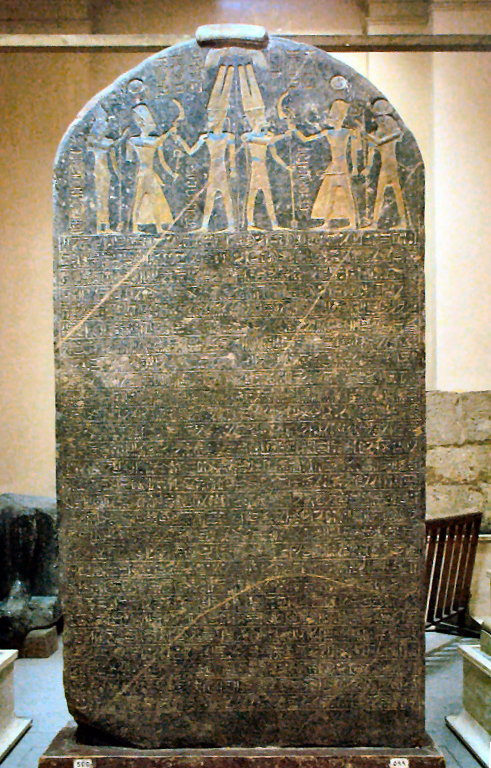
Merneptah Stele – Egyptian Museum, Cairo
Credit: Wikipedia
The Hebrew Bible, thanks in large part to the often literal translation of it in the King James Version, is a source of scores of English idiomatic expressions. We may not know much about biology and history, but we do know, for instance, that a “leopard cannot change its spots” and that there is “nothing new under the Sun.” (See Jer. 13:23; Eccles. 1:9.)
Someday, no doubt, if it hasn’t already, Google will track the frequency with which we use these expressions and determine the rank order of their popularity. Surely high on the list will be “written in stone.” The phrase comes from the Book of Exodus where we are told that Moses ascended Mt. Sinai and received from God two stone tablets which were engraved by God with God’s teachings and commandments. The initial set of tablets was then smashed by Moses when he saw that the Israelites had fashioned an idol, a golden calf, when he was away up the mountain. God then met with Moses a second time, resulting in the production of a second set of stone tablets with the laws. (See Ex.24:12; 31:18; 32:15-19; 34:4; 34:28.)
From these references comes the notion that something written in stone is fixed for all time, immutable. The writing is a statement from and by authority, possibly even sacred, but certainly to be followed without modification. Conversely, something “not written in stone” is a statement of lesser seriousness, one subject to challenge and change. read more