Subscribe

Subscribe to receive new posts:
Available Now!
When Judaism Meets Science


Archive for the ‘History’ Category
The Evolution of Human Spirituality
Religion is not a maladaptive “illusion” (Freud), nor is religion a manipulative “opiate” (Marx). Religious behavior is a ubiquitous biological adaptation rooted in Homo Sapiens, because religion like intelligence and language helps human communities survive. Religion, like intelligence and language, can be used for both good and evil purposes, but this is also true of culture, science, politics and all other important human activities. Since almost all revealed religions teach that humans have a pre-birth soul that predisposes them to respond to a Divine call even before the revelation occurs, I identify the existence of a biologically based, self-conscious spiritual soul with the evolution of Homo Sapiens spirituality.
A reference to a prescriptural, prehistoric period when spiritual evolution was unaided by God appears in the book of Genesis (4:26) where it states, “At that time humans began to invoke YHVH by name.” Most of the rabbinic commentators translate the verb hukhal to mean ‘profane’ taking this as a negative statement. But ‘began’ is the more normal meaning of the verb. The Torah asserts that prior to Enosh humans did not practice religion based on the divine insight of revelation (i.e., “invoke YHVH by name”) that they were able to do later. Mystical and spiritual experiences were interpreted by human intelligence without the benefit of prophetic revelation. In the spirit of this Torah insight I offer the following account of the evolution of pre-historic human spirituality. read more

The Camel’s Nose and the Torah’s Tent

The time is out of joint – O cursed spite,
That ever I was born to set it right!
Nay, come, let’s go together.
Shakespeare, Hamlet, I, 5
For those who hold that the Bible, and particularly the Torah, is the Word of God, without flaw and inerrant, the last few hundred years have been very frustrating. The development of the Documentary Hypothesis, the idea that the Torah was a compilation of works from several discrete sources, was and, despite scholarly challenge, remains a formidable obstacle to the claim of unitary and divine authorship. But the Documentary Hypothesis is, for all its power and value, just that, a hypothesis. Similarly, the notion that much of the Torah text is pretext, i.e., a series of allegories designed to enhance the image of one or more Kings of Judah, is another provocative and persuasive concept, but again, just that, a concept.
Yet while some would dismiss such broad theories as too sweeping, and not definitive, small, stubborn little problems with the text cannot be so easily refuted and disregarded. One sign that the Torah is not the work of a single writer, much less a divine one, is the presence of anachronisms in the text. read more
Let My People Know, Let My People Think: Why it Matters that the Bible is Fiction
In recent years, in certain circles, it has become fashionable to assert that the Bible is fiction, or that at least key segments of it are fictional. The assertion emanates from two camps. In one of these camps are those who have been described as new or militant atheists. Looking to recent developments primarily in cosmology and archeology, folks like Richard Dawkins, Victor Stenger, Samuel Harris and the late Christopher Hitchens have created more than a cottage industry in their efforts to debunk the Bible.
But scientist and skeptics are not alone in their contention that the Bible is fiction. In another other camp are scholars of the Bible, including notable rabbis. For instance, during Passover week a dozen years ago, Conservative Rabbi and prolific author David Wolpe set off a firestorm when he spoke to his Los Angeles congregation about the lack of hard evidence for the Exodus story. According to a writer for the Los Angeles Times, after reviewing revolutionary discoveries in then current archeology, Rabbi Wolpe told them: “The truth is that virtually every modern archeologist who has investigated the story of the Exodus, with very few exceptions, agrees that the way the Bible describes the Exodus is not the way it happened, if it happened at all.” (A subsequent summary of Wolpe’s thinking may readily be found on the Internet in a piece he authored called “Did the Exodus Really Happen?” (“Did It?”).) read more
Jews, Genes and Genetics: A Look at Family, Haplotypes and Peoplehood
In the United States today, the freest and richest nation on the planet, a country characterized by opportunity and mobility, the reality is that most Jews are Jews, if at all, by choice. For some, that choice is relatively easy, a coincidence of birth, culture and acceptance. For others, the situation is more complicated, involving perhaps disaffection with the faith or circumstances into which one was born and raised or, conversely, an attraction to a set of beliefs or patterns of behavior newly encountered.
Regardless of one’s position, in the open and fluid society that is America, most adults are not forced to be Jewish, i.e., to engage in conduct commonly understood to be specifically Jewish, such as attending shul, keeping kosher, studying sacred texts or simply identifying as a Jew. Nor are they forced to believe in a particular collection of ideas or ideals, including whether God exists, or, if they think that God does, what attributes or aspects that God may or may not have. Certainly strong social pressures can operate on an individual to motivate him or her to behave or believe one way or another, but most individuals still retain the ability to choose whether to be Jewish.
There is, however, one matter that is not open to choice, much less dispute or revision, and that is one’s genetic structure. And here, as elsewhere, advances in science in the relatively recent past have allowed us to investigate, to probe, to attempt to provide science based perspectives, if not answers, to the most basic questions: “Who am I?” and “Where did I come from?”. read more
When “Written in Stone” is More than a Phrase, and may Even be Evidence: A Gray Granite Pedestal and the Ethnogenesis of Israel
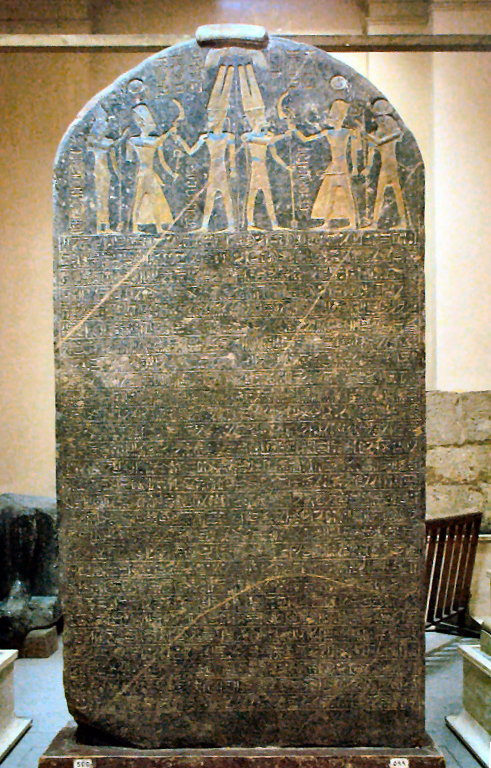
Merneptah Stele – Egyptian Museum, Cairo
Credit: Wikipedia
The Hebrew Bible, thanks in large part to the often literal translation of it in the King James Version, is a source of scores of English idiomatic expressions. We may not know much about biology and history, but we do know, for instance, that a “leopard cannot change its spots” and that there is “nothing new under the Sun.” (See Jer. 13:23; Eccles. 1:9.)
Someday, no doubt, if it hasn’t already, Google will track the frequency with which we use these expressions and determine the rank order of their popularity. Surely high on the list will be “written in stone.” The phrase comes from the Book of Exodus where we are told that Moses ascended Mt. Sinai and received from God two stone tablets which were engraved by God with God’s teachings and commandments. The initial set of tablets was then smashed by Moses when he saw that the Israelites had fashioned an idol, a golden calf, when he was away up the mountain. God then met with Moses a second time, resulting in the production of a second set of stone tablets with the laws. (See Ex.24:12; 31:18; 32:15-19; 34:4; 34:28.)
From these references comes the notion that something written in stone is fixed for all time, immutable. The writing is a statement from and by authority, possibly even sacred, but certainly to be followed without modification. Conversely, something “not written in stone” is a statement of lesser seriousness, one subject to challenge and change. read more